
The Bowl of Light – A Story of Turning Cracks into Strength
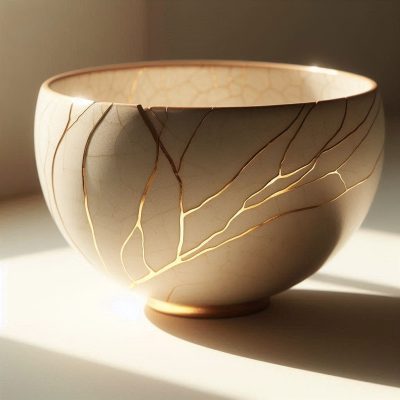
While thinking about how often we hide our weaknesses, this Kintsugi story of self-worth came alive in my thoughts. The Japanese art of Kintsugi teaches that what’s broken can become beautiful again. Maybe our emotional cracks are not signs of failure, but places where strength is born.
Mira was good at noticing. She noticed how effortlessly others spoke, how her classmates seemed to shine online, how her friends’ lives looked like curated reels of confidence. She noticed everything—except her own worth. Each scroll through social media carved a new crack of self-doubt.
Her room had always been her safe space, small but quiet, a nest of books and forgotten corners. One evening, while clearing a shelf near the window, she found an old ceramic bowl wrapped in yellowed newspaper. Its surface was webbed with cracks, some filled with dust. She couldn’t remember where it came from—perhaps her grandmother’s. She placed it on her study table, meaning to throw it away later.
But she didn’t.
Every day, the bowl caught light in strange ways. When morning sun slipped through the curtains, thin golden threads ran through its broken lines. Mira would glance at it while studying and feel something tug inside her. The bowl was like her—flawed, patched, fragile.

At first, that thought made her uneasy.
Each crack reminded her of what she wasn’t: not confident enough to speak up in class, not talented enough to post her drawings online, not bold enough to say no when she wanted to. The bowl became a quiet mirror of her own hesitations.
One afternoon, while she sat sketching by the window, laughter floated in from the garden below. Some neighborhood kids were playing with clay, shaping small pots and then—oddly—breaking them apart again, giggling as they rejoined the pieces with sticky paste.
“What are you doing?” she called down.
A little boy looked up and shouted, “We’re making new ones! Look—they look cooler after breaking!”
Mira smiled faintly but his words stayed. Cooler after breaking.
That evening she searched online about broken pottery and stumbled upon the Japanese art of Kintsugi—repairing cracks with gold, turning damage into beauty. The word itself meant “golden joinery.” Her eyes lingered on a sentence: In Kintsugi, the break is not the end of an object’s life but proof of its journey.
She looked again at her old bowl.
The next day she visited a local craft store and bought a small packet of golden resin used for ceramic repair. She watched tutorials, her hands trembling as she began filling each crack carefully. The gold line spread like veins of light across the dull surface. The bowl, once lifeless, started to gleam in the sunlight.
But something unexpected happened as she worked. She began to think about her own cracks—the things she wished away. Her anxiety before presentations, her awkward silences, her perfectionism that made her erase every sketch five times. For the first time, she wondered: What if these, too, were part of my design?
That thought didn’t erase her self-doubt overnight, but it changed the way she held it.
Over the following weeks, Mira started drawing again—not perfect portraits, but messy sketches that carried the texture of her feelings. She shared one on her art page, expecting indifference. Instead, people left warm comments, saying her work felt real. She realized her vulnerability was the gold joining her cracks.
One afternoon, her friend Neha dropped by. Spotting the bowl on the table, she picked it up. “This is beautiful! Where did you buy it?”
Mira smiled. “It was broken. I repaired it.”
Neha traced a finger along the golden seam. “I like that the cracks show. It looks… alive.”
Mira nodded. “I used to think broken meant useless. Now I think it just means lived.”
That night, a power cut plunged her room into darkness. She lit a small candle, and the flame reflected off the golden lines of the bowl. The glow danced like veins of light, illuminating her sketches on the wall. The cracked bowl no longer looked fragile—it looked whole in a new way, as if the gold had become its strength.
She whispered softly, “Maybe I’m like that too.”
Weeks later, Mira’s art teacher announced a small exhibition. She hesitated but decided to submit one of her sketches—a portrait of a bowl filled with light. Beneath it, she wrote:
“Strength is not in what remains unbroken, but in what learns to shine through its cracks.”

When the exhibition opened, Mira stood quietly at the back, watching strangers pause at her drawing. Some smiled, some nodded. The old feeling of comparison tried to creep in, but she caught it mid-step and let it dissolve.
Because she finally understood:
Her worth was not measured by perfection but by presence—by the courage to rebuild herself, again and again, with a little gold of self-understanding.
The bowl still sat on her table, humble and luminous. Whenever self-doubt whispered again, she touched one of its golden lines and remembered—every flaw was a place where the light could enter.
This story reminds us that weakness is not the opposite of strength—it is the raw material from which strength is shaped. Like Kintsugi, life repairs us with meaning when we allow ourselves to heal instead of hide.
If you enjoyed this reflection, you may also like The Potter King – A Motivational Story on Patience and Persistence, a timeless tale that celebrates faith, patience, and quiet perseverance.